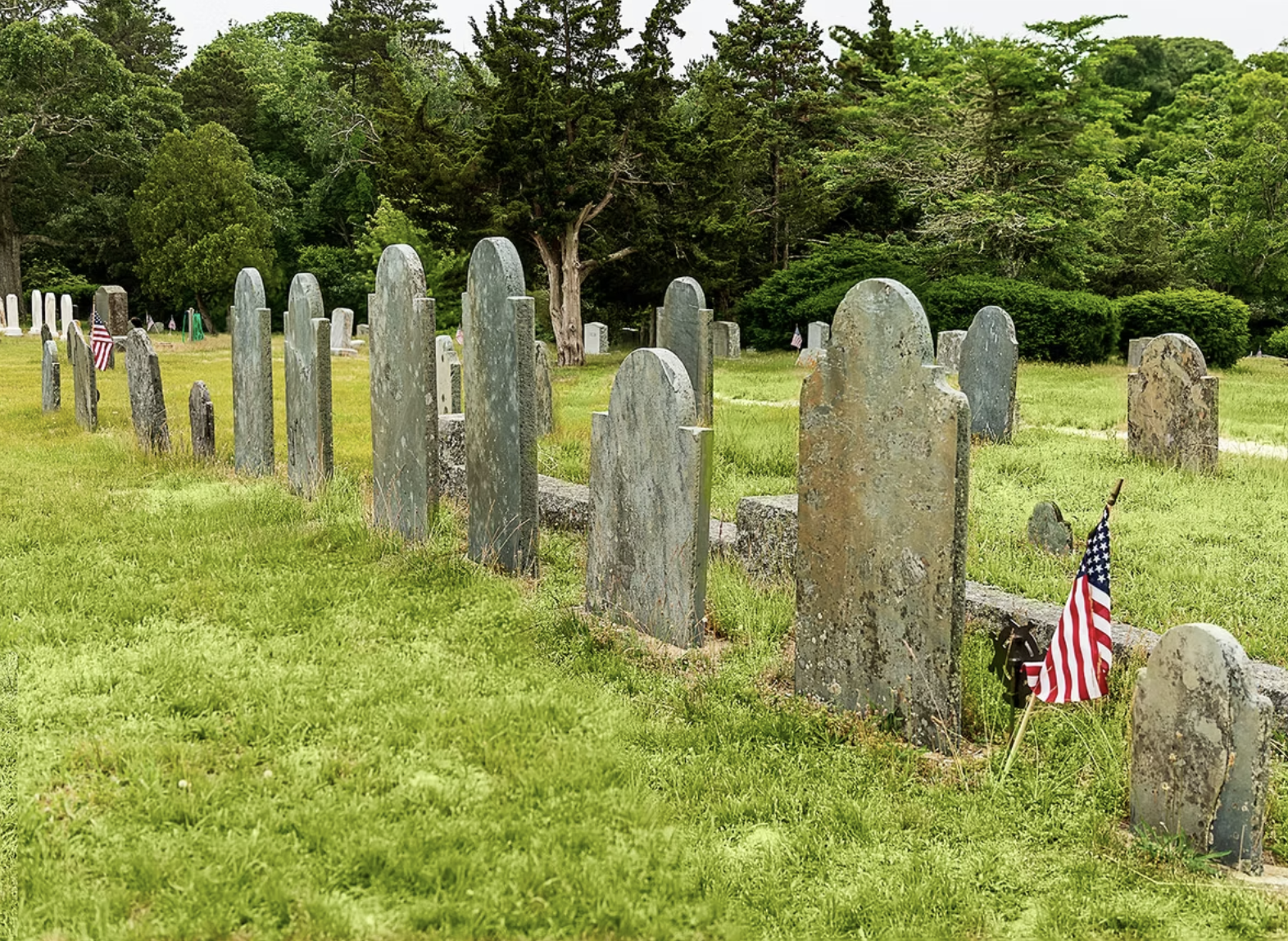
Until the middle of the 19th century, most burials were made in corners of lots, in land set aside for burial grounds, and in church graveyards. People were interred in what is now Ancient Cemetery soon after the church was built there in the 1600s, but early graves were usually marked with wooden posts and the markers seldom lasted more than a generation. Carved gravestones were expensive and difficult to obtain. The earliest gravestone in the cemetery is for Margaret Miller from 1698.
Massachusetts and other states would not allow smallpox victims to be carried past houses. This resulted in additional small burial plots located throughout the town away from the general population. Yarmouth has at least three created just for this reason.
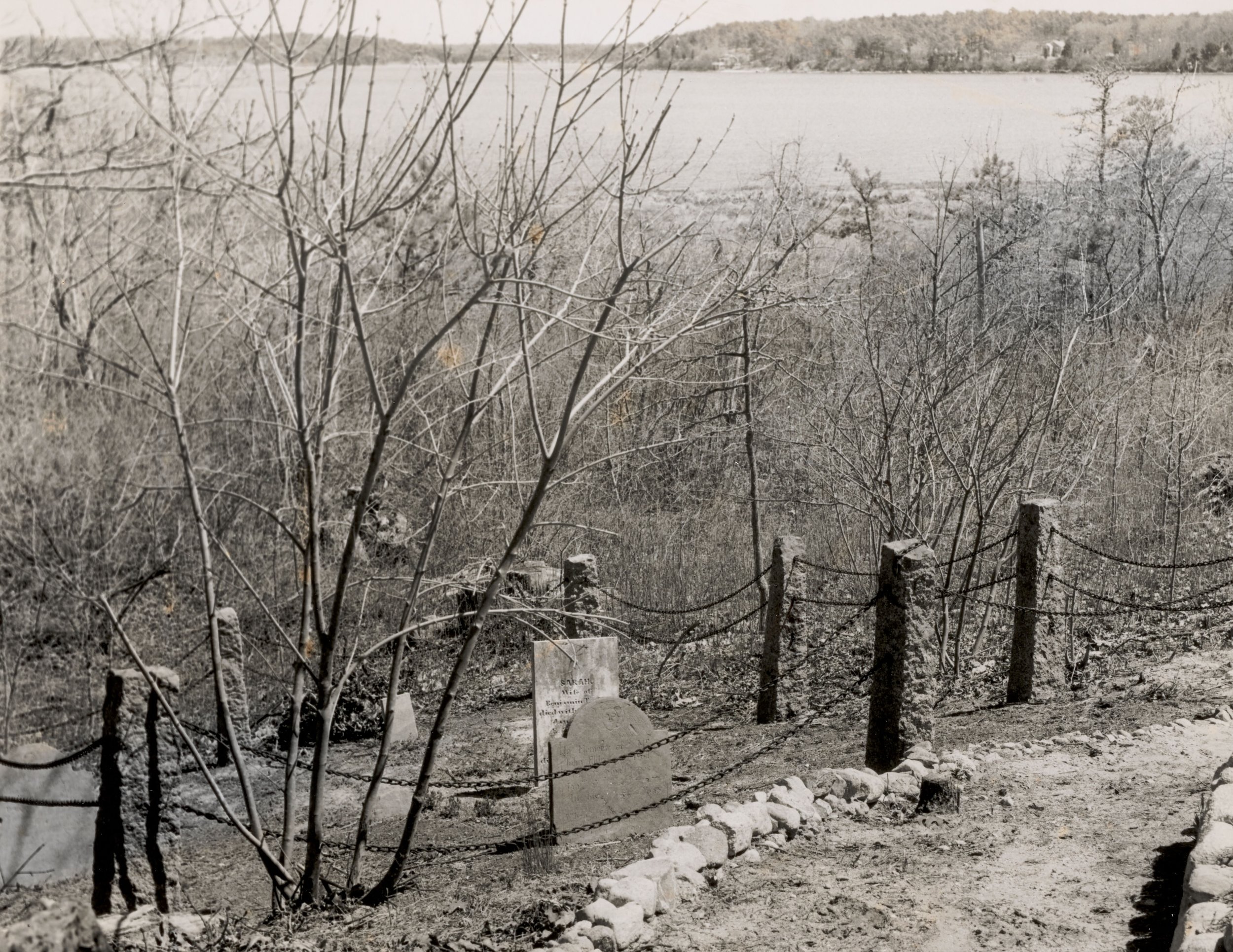
A smallpox burial plot near Follins Pond.
Prior to 1831, there were no “cemeteries” in America, only graveyards. The difference? A graveyard is usually associated with a place of worship while a cemetery is secular and park-like in nature, often owned by a community rather than in a churchyard. The building of Mount Auburn Cemetery in Cambridge, MA started a nationwide movement to beautify the locations where people were buried and even use them as public parks or picnic areas. It was the first to plan landscaping in a cemetery. The origins of American public parks can be traced in part to this movement.
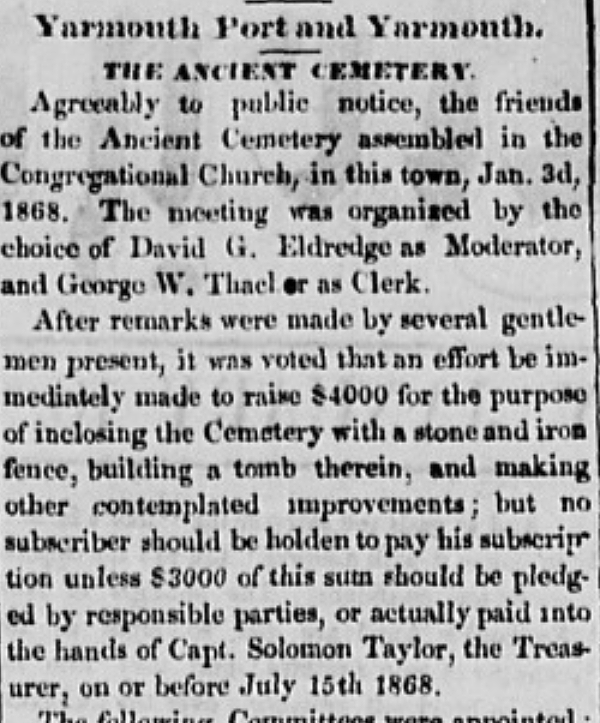
It wasn’t until 1868 that Yarmouth residents started beautifying Ancient Cemetery. Residents met and organized as the friends of the cemetery, first known as a burying yard. The meeting took place on January 3rd at the Congregational Church and David Eldredge was chosen as moderator. They voted to raise $4000 “for the purpose of inclosing the Cemetery with a stone and iron fence, building a tomb therein, and make other contemplated improvements: but no subscriber should be holden to pay his subscription unless $3000…is actually paid … before July 15th, 1868.”
Nearly $2,000 was pledged that evening according to the Yarmouth Register. Reverend Nathaniel Cogswell was the largest donor giving $500, and six others gave $100 or more. The fence was installed, the tomb built, and graves straightened into fairly straight rows. Prior to this, while people were generally buried with their feet to the east and head to the west, there were no orderly rows of graves and many were unmarked.
Trees were planted along the fences. There is old Yarmouth lore that the trees at Ancient Cemetery were planted when Abraham Lincoln was assassinated in 1865, but this may not be true as the cemetery improvements began three years later.
Those planning the design of Ancient Cemetery felt the north side was less desirable and paupers were to be buried there, including the residents from the Yarmouth Almshouse. The planners also kept the southeast corner of the cemetery as it was, without stones, as this was where the people of color and Indigenous people’s graves were moved after an infamous town meeting in 1826. That year Yarmouth voters authorized having “all people of colour removed from the place where they are now deposited and bury them in the Southeast corner.” This incident was a sad indication of the treatment they received. Even today with all of the subsequent changes to the cemetery, one can still see the outline of this area with its sparse cemetery grass and lack of gravestones.
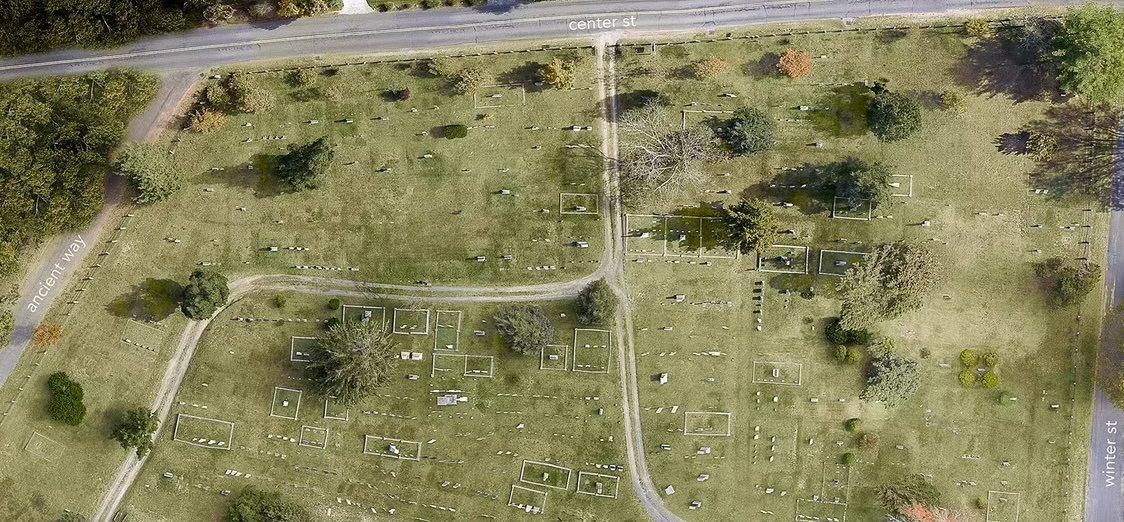
The southeast corner of the cemetery can be seen upper right in this drone view of the cemetery. The north side of the cemetery is far left.
Eventually the town took over this burial ground and occasional notations in the newspaper told of happenings there. After town meeting approval on Sept. 27, 1920, a macadam road from Main Street to Ancient Cemetery was put in. The road wasn’t macadamized further north toward Bass Hole, with later serious affect when the former Almshouse burned and the responding fire truck became stuck in the road and unable to reach the fire.
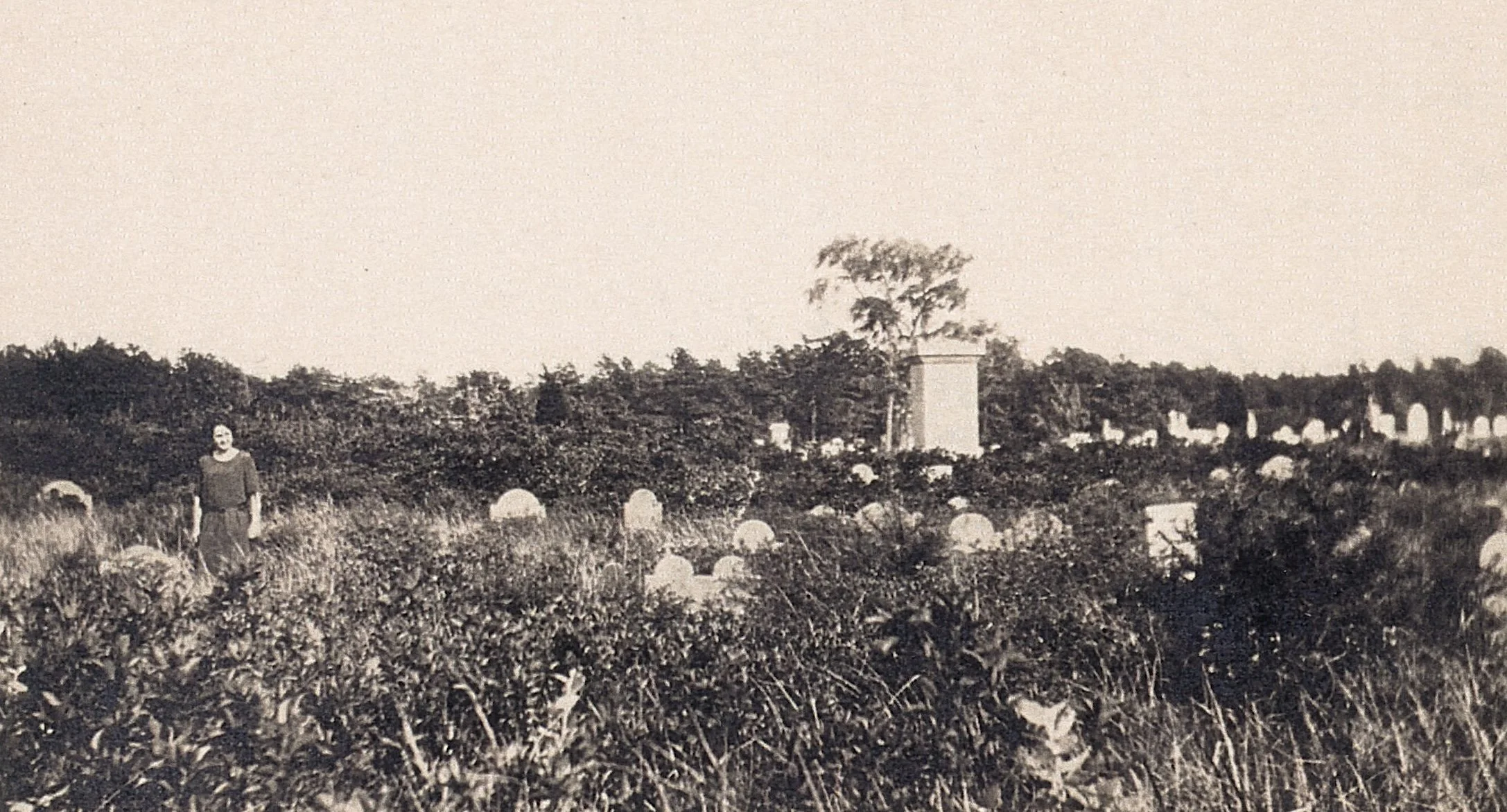
The Ancient Cemetery, ca 1925.
In October of 1928, gravestones in the old part of the cemetery were cleaned and put “into condition” by a crew from Boston, thanks to the generosity of Thomas C. Thacher.
The graveyard at the corner of Route 28 and West Yarmouth Road was also called Ancient Cemetery by those nearby. It was later renamed Woodside Cemetery, likely from an earlier era when trees were nearby. It had a wooden fence until 1884 when it was replaced by stone and iron. The granite posts used at this cemetery were similar to those at Ancient Cemetery in Yarmouth Port and two at the entrance are carved “July 1884.”
Woodside Cemetery on Summer Street in Yarmouth Port is the only private cemetery in town and it grew from the original Sears family burial plot. In the 1850s and 60s land was bought and the cemetery formally organized, but by that time there were already 250 burials dating back to 1797. Burials in a smaller nearby cemetery on the far shore of Dennis Pond were moved to Woodside too.
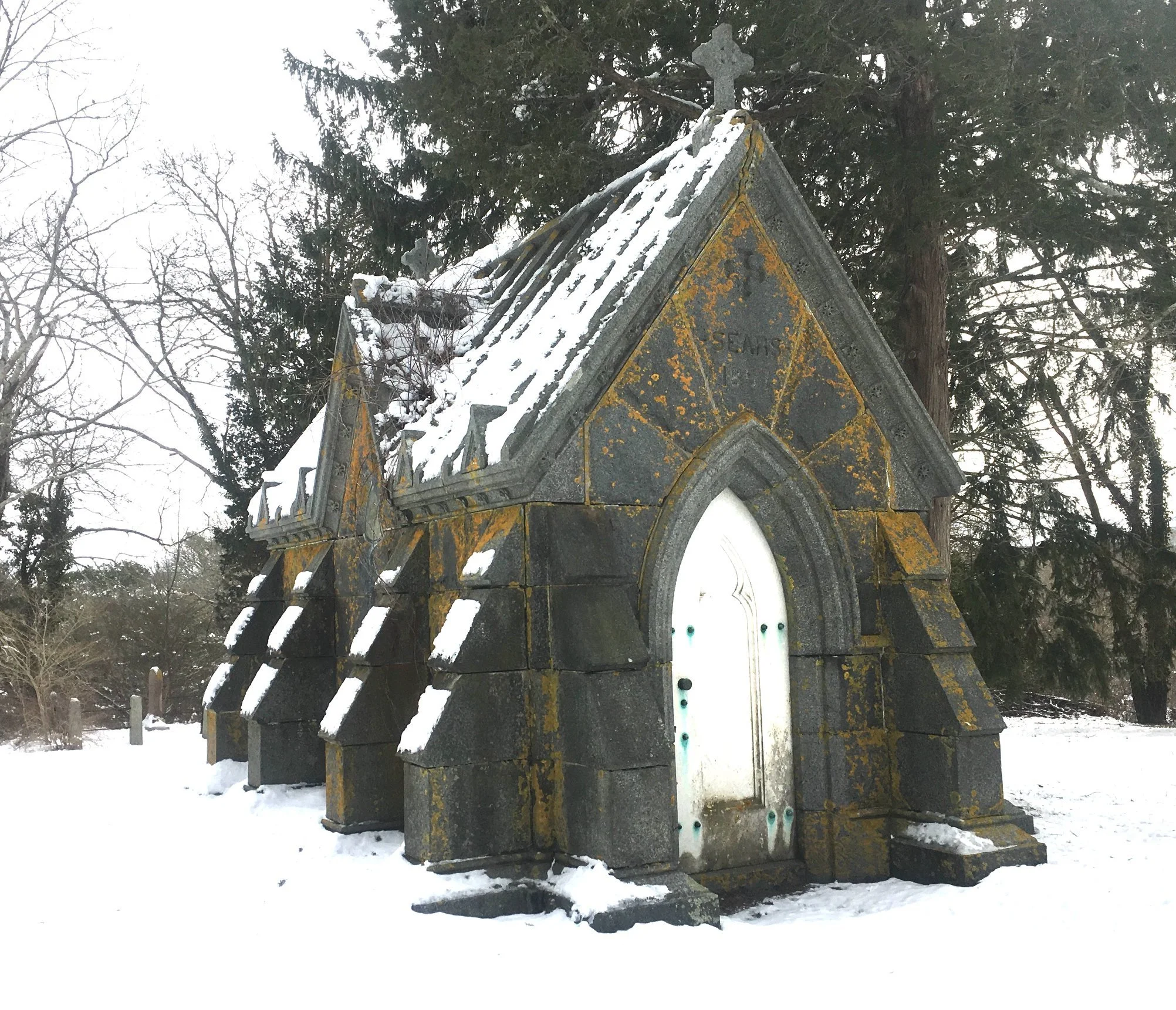
The Sears family tomb in Woodside Cemetery, which dates to the 1850s.
In recent years work has taken place in Ancient Cemetery to once again clean and repair the gravestones. The Friends of Ancient Cemetery have worked with the town cemetery department, applied for grants for restoration, organized gravestone cleaning and genealogy volunteers, planted flowers, documented the burials and much more.
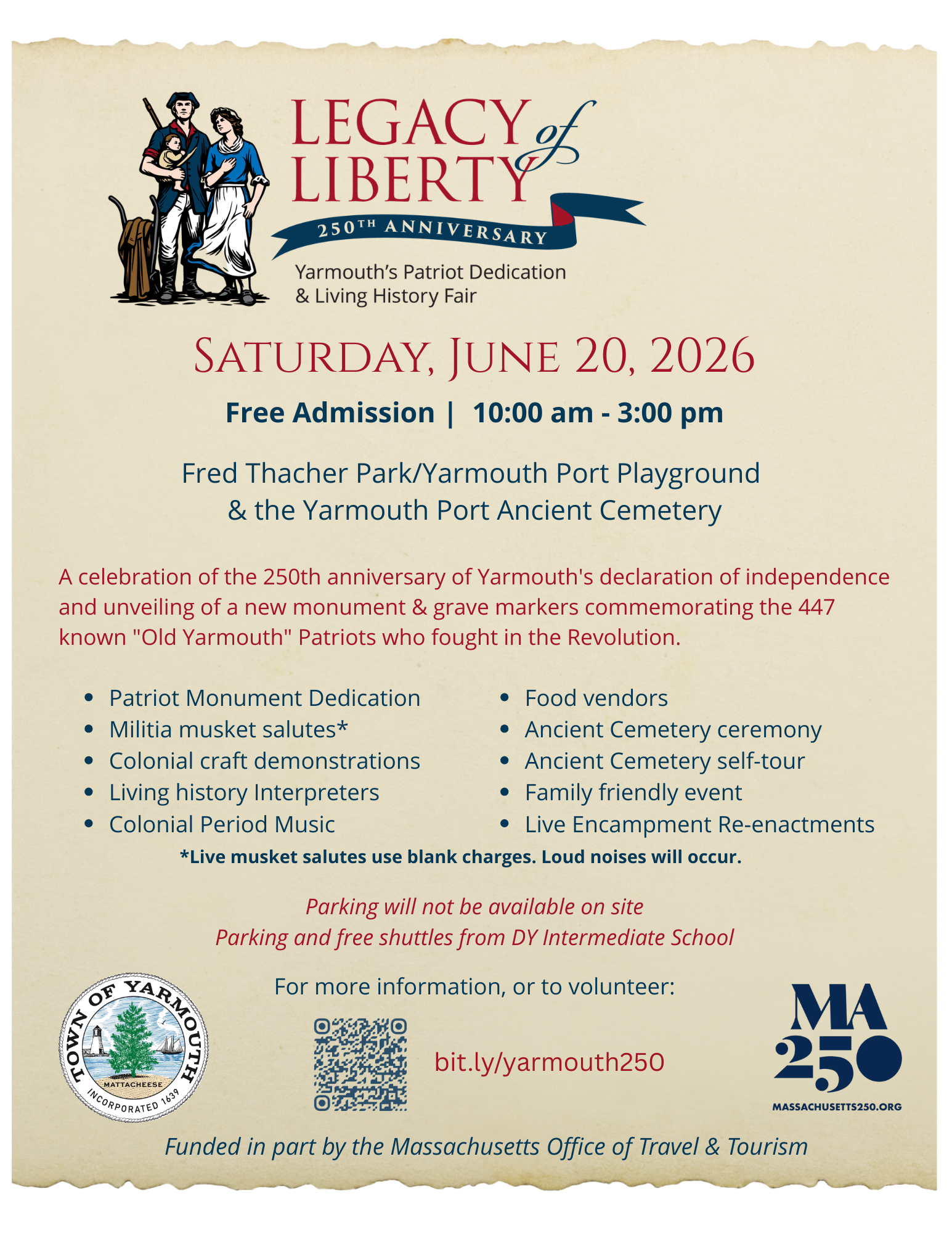
And in June of 2026, a monument dedicated to the 447 Revolutionary War veterans from Yarmouth (and Dennis, which was still part of Yarmouth during the war) will be erected at the Yarmouth Port playground. All of the patriot graves in Ancient Cemetery have been specially marked. A dedication ceremony and cemetery tour will take place on June 20th. All are welcome to attend this free celebration and volunteers are needed. More information can be found at bit.ly/yarmouth250
Based on an article researched and written by Duncan Oliver.