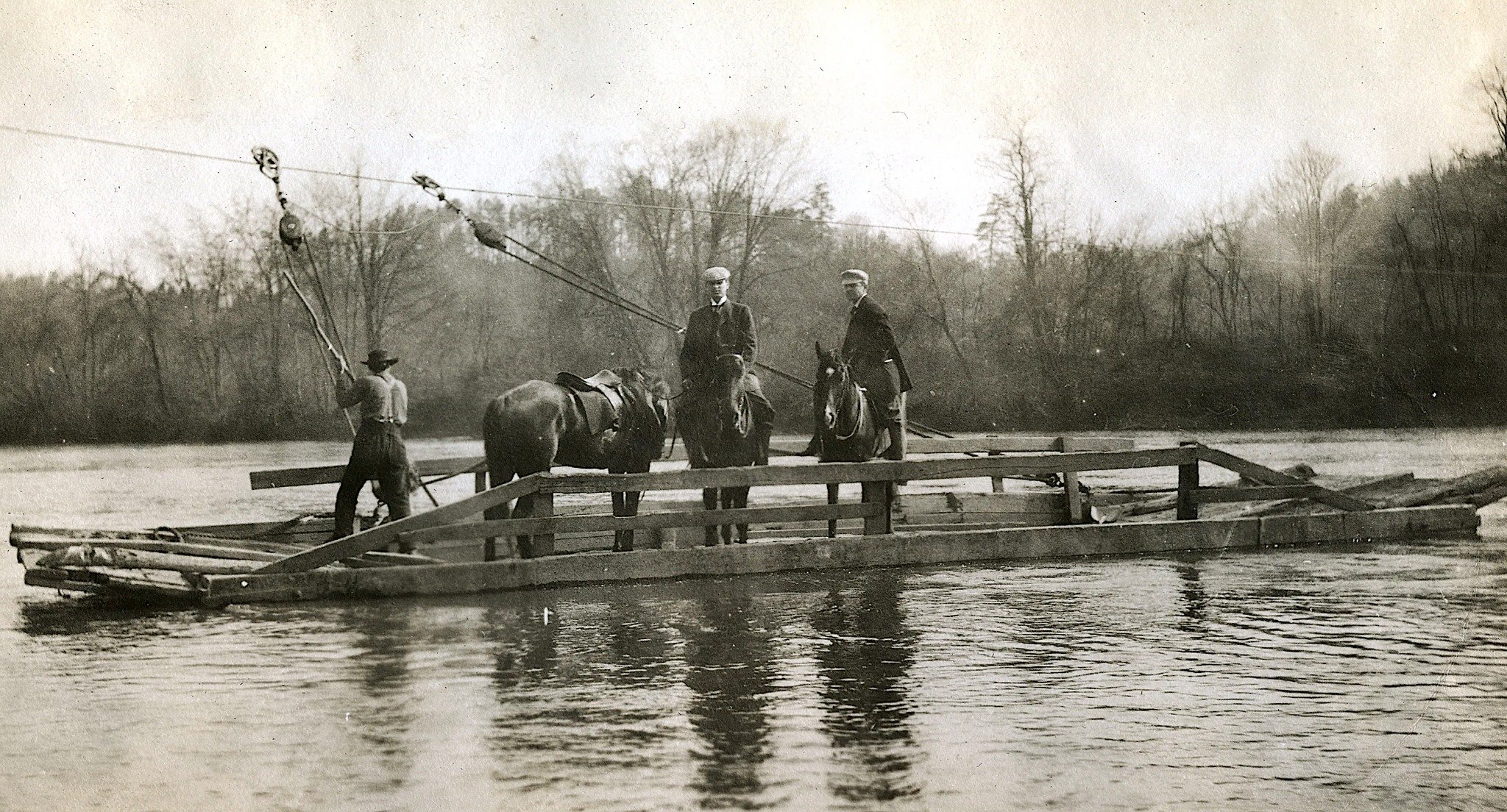
Bass River was a great obstacle to east-west travel on Cape Cod in the 17th and 18th century. Because passage was only available by land near the northside of the Cape, it was natural that the bayside settlements developed first. There were several ferry locations on Bass River, but those depended upon time, weather, and where the ferry was located when you needed it. Murphy’s law dictated that the ferry was always on the other side of the river if you needed it or had stopped operating for the day.
Early in the 19th century, people began to express the need for bridges. The Bass River ferry wasn’t a favorite with some Yarmouth residents, and they requested that a bridge be built in 1807 because the ferry service was so poor. The HSOY archives has that written request, which was turned down. Opposition came from those who didn’t want to spend the money, and of course, those who owned the ferry. Another issue was the fact that bridges blocked the river for sailing vessels. Having a draw bridge across the river limited movement for a sailing vessel, especially in a contrary wind.
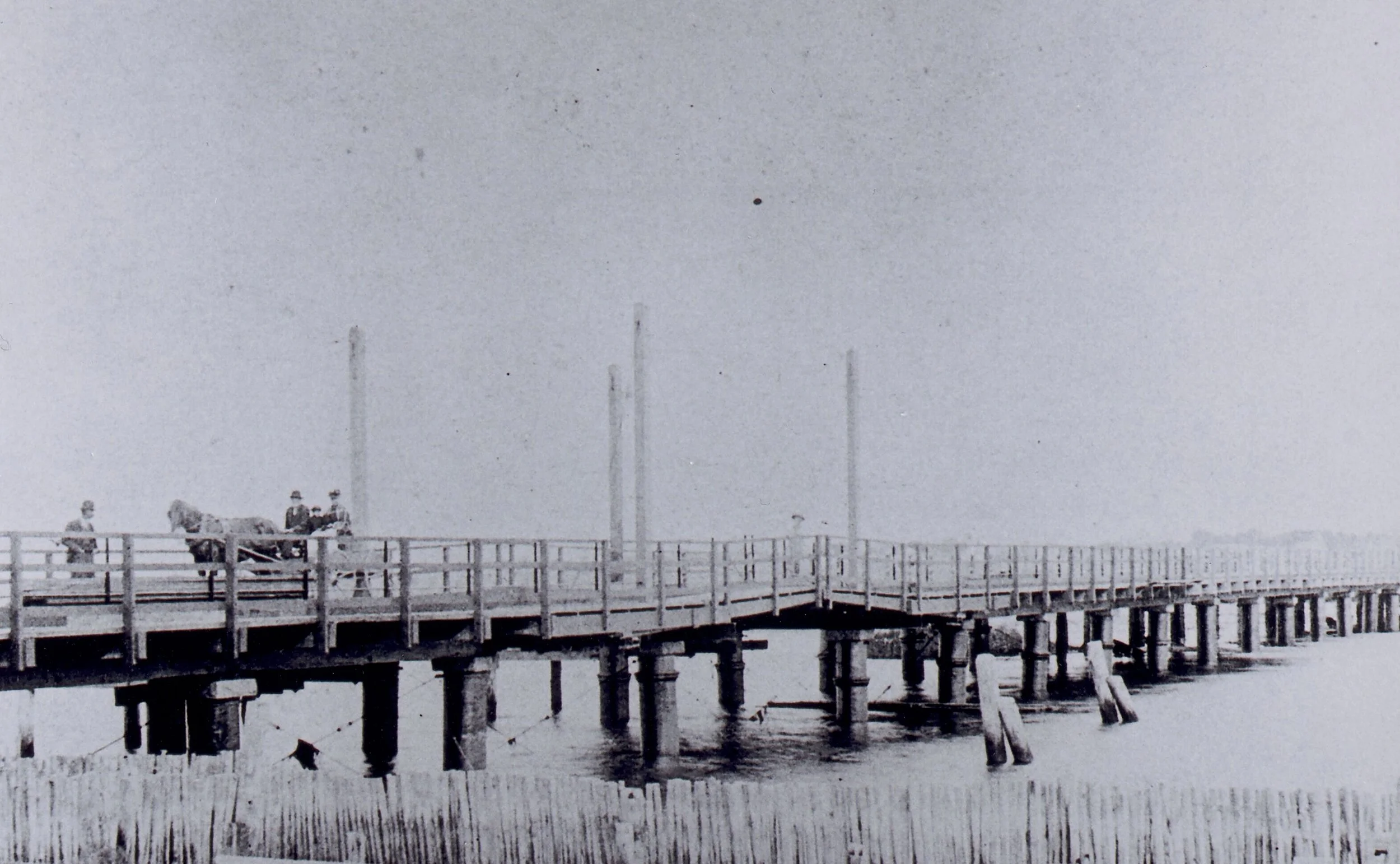
The Bass River Bridge with a draw in the middle.
Even when the first bridge opened over Bass River up near Blue Rock after the War of 1812, those in South Yarmouth and West Dennis still relied on a ferry. This ferry was run mostly from the Dennis side. Ted Frothingham, writing about Bass River prior to 1832, when the lower bridge was built, noted: “David Kelley had the charter for the ferry, and later ‘Uncle’ Elihu Kelley. They had a variety of craft they used in their business depending on just what had to be carried. They had a flat barge to take a horse and carriage on, and the fee was twenty-five cents. Passengers were charged two cents for a crossing, and they might make it in a skiff, or a larger craft if there were a number of them. Sometimes the boats were poled across and sometimes propelled by oars or great sweeps. The ferry men, for the most part, lived over on the Dennis side of the river and had to be summoned to South Yarmouth by blowing on a great conch shell which was hung on a post. Apparently Elihu liked his job in spite of its occupational hazards, because when 1832 rolled around and the first bridge got its charter and was built, he was very bitter and remained so until his death in 1841.”
To get to the Islands, it was necessary to find a sailing packet, and the Hyannis inner harbor had a sandbar. Thus, some left from Gage’s Wharf, located on what is now Bay View Beach near Cape Cod Hospital. And yes, it is a Yarmouth beach! Captain Freeman Matthews was one of the Barnstable men who carried mail and passengers to Nantucket. Steam power, jetties, dredging, and a lighthouse helped make the inner harbor more accessible. Bow thrusters came much later, in the 20th century.
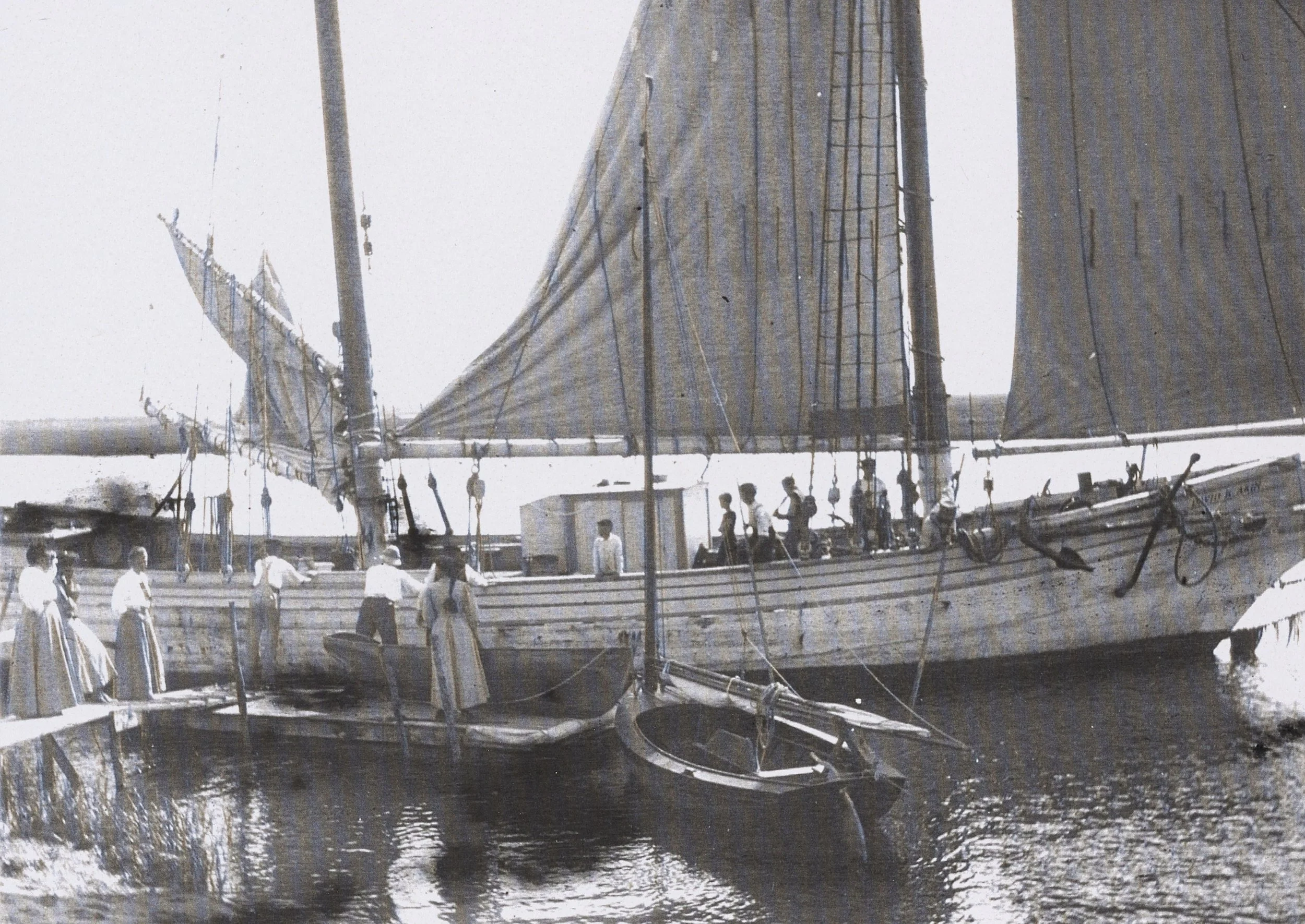
The packet ship David K. Aiken in Bass River, also took passengers on some runs.
The arrival of the railroad to Cape Cod in the early 1850s improved service and reliability of travel. In 1854, the railroad line was extended through to Hyannis. A rail extension, now known as Old Colony Road, went down to a wharf where vessels tied up to take passengers to Nantucket. A steamboat company started in Nantucket in 1832. In 1855, the Nantucket and Cape Cod Steamboat Company was formed for the Hyannis trade. A faction in New Bedford were major stockholders in a rival shipping company. Their aim was to prevent the Nantucket business from going to Hyannis. The two companies finally joined forces and consolidated in 1886.
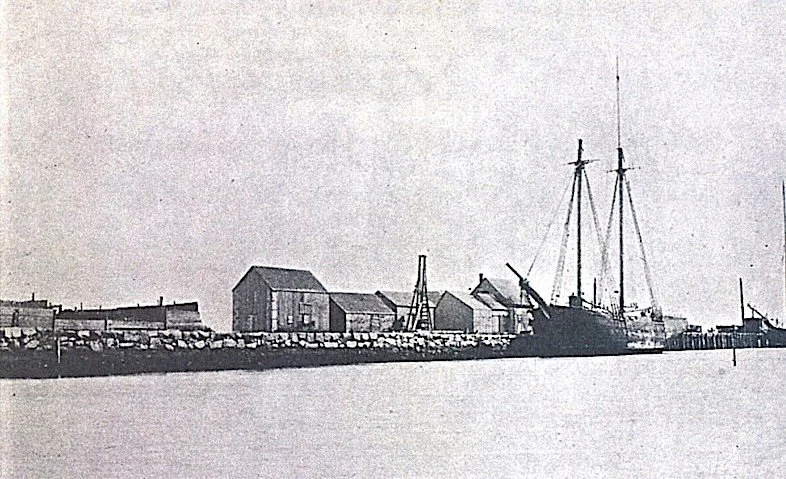
The Hyannis wharf at the end of the Old Colony railroad spur.
According to the Steamship Authority’s website: “The present Woods Hole, Martha's Vineyard and Nantucket Steamship Authority was formed from the New Bedford, Martha's Vineyard, and Nantucket Steamboat Co., which in turn was a consolidation of earlier companies dating to the early 19th century, just before the railroad arrived.” When the railroad arrived in Woods Hole in 1872, much of the ferry business went there. By 1914, 50,000 passengers were travelling across Nantucket Sound each year.
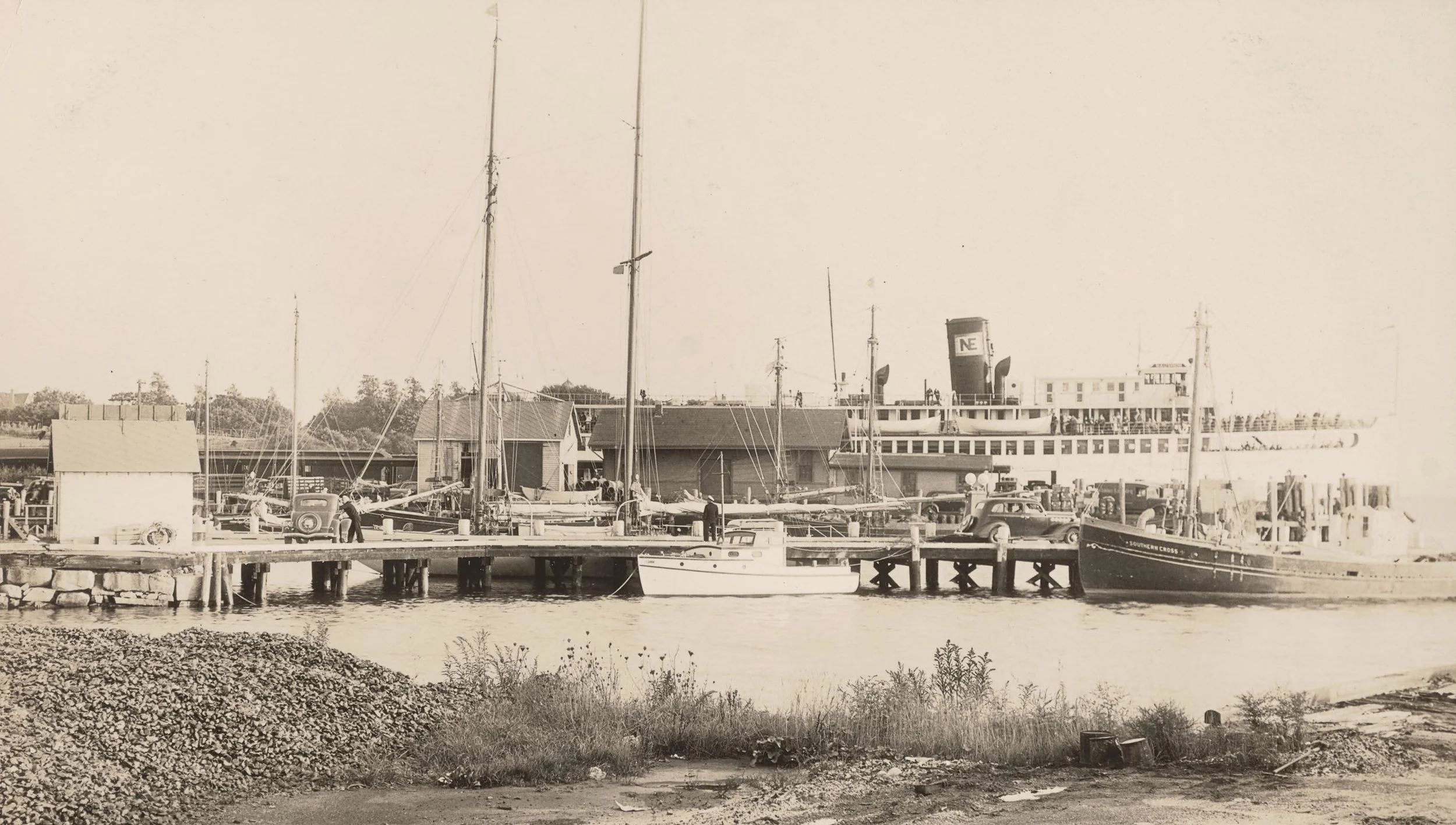
Woods Hole Ferry dock, 1930s.
Looking at the vessels purchased by these groups until the 1950s, it is obvious that certain periods were “slower” than others. Only one vessel was purchased between 1856 and 1871 (the Civil War); none purchased between 1911 and 1923 (World War I); and none between 1929 and 1947 (the Great Depression and World War II). Some boats were requisitioned for war service.
During the last “slower time,” a Hyannis man, Daniel Fern, headed the formation of the Nantucket Boat Company in 1946. It ran between Hyannis, Nantucket, and Martha’s Vineyard until it was bought out by Hy-Line in 1972. From the Hy-Line website: Hy-Line Cruises began operations in 1962 as Hyannis Harbor Tours run by Richard Scudder and his brother Robert. Originally, the company focused on sightseeing harbor tours, which it still does today. [Seeing the Kennedy Compound from the water was a major tourist attraction from 1960 onward.] The company added deep sea fishing charters in 1966, and started running seasonal passenger ferry services in 1970, first to Martha's Vineyard, and then to Nantucket in 1972 when Hyannis Harbor Tours bought out The Nantucket Boat Company which at that time was doing business as Hi-line. Hyannis Harbor Tours took this trade name and changed it to Hy-Line.
In 1960, the Massachusetts legislature created the Woods Hole, Martha's Vineyard, and Nantucket Steamship Authority to provide for “adequate transportation of persons and necessaries of life for the islands of Nantucket and Martha's Vineyard.”
This legislation empowered the Steamship Authority to acquire, maintain and operate a boat line between the mainland ports of Woods Hole and Hyannis and the islands of Martha's Vineyard and Nantucket and generally precludes any ferry service that would directly compete with the Steamship Authority, essentially giving it a legal monopoly on all auto ferry service to the Islands. However other companies were “grandfathered” to operate smaller passenger ferry operations to the islands due to their existence prior to the SSA's creation.
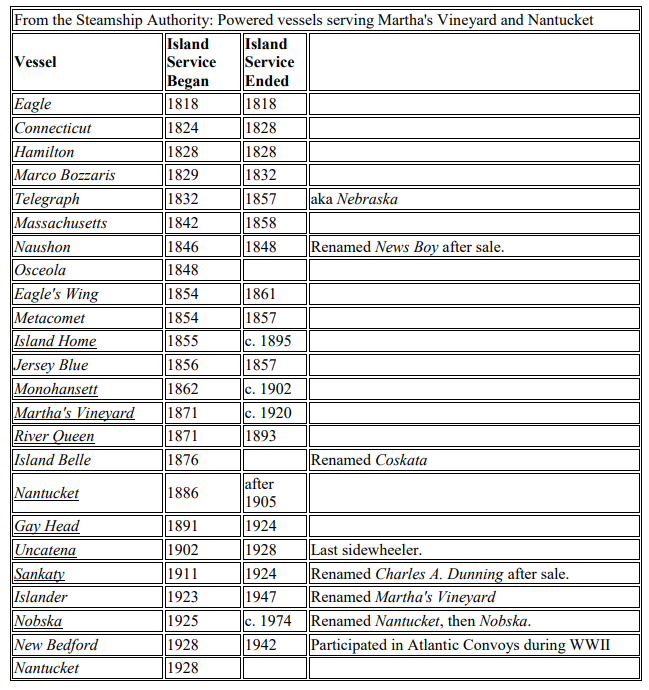
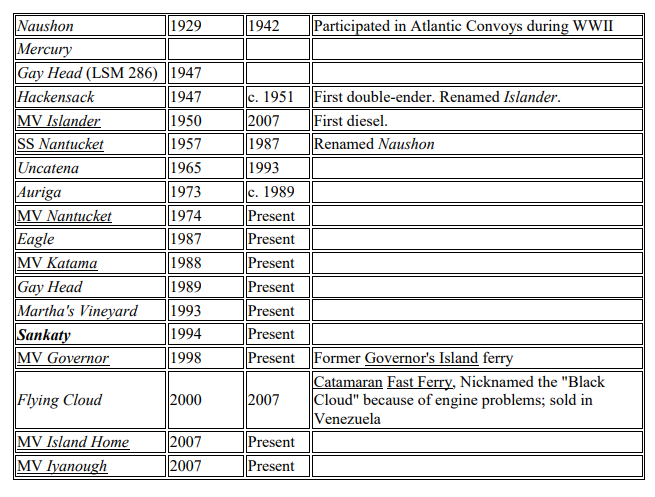
Many thanks to the Steamship Authority and Hy-Line for material on their websites used in this article.
Researched and written by Duncan Oliver and Marie Kesten Zahn
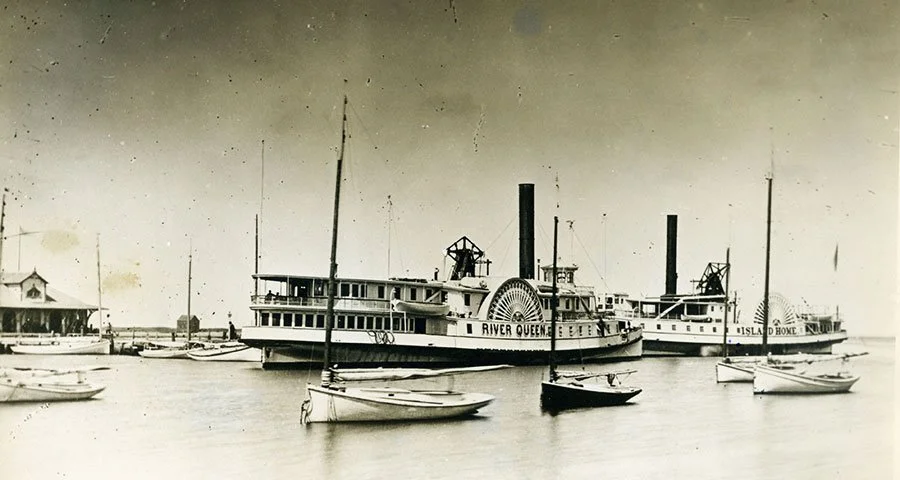
The River Queen ferried passengers to Nantucket during the last third of the 19th century.